
Surprising Facts About Gold: From Ancient Coins to Space Asteroids

Gold has long been celebrated for its rarity and beauty, making it one of the most sought-after materials in history, but many people don’t actually know much about what makes it so valuable.
Whether you’re just starting your investment journey or are a seasoned collector, this article will guide you through the fascinating world of gold. We’ll delve into its rich history, unique properties, and enduring investment potential, offering insights that will help you make informed decisions as you build and expand your collection.
The fascinating history of the gold standard
The first gold coins: A glimpse into ancient wealth
Gold has captivated humanity for millennia, and its allure is perhaps best exemplified in the history of the first gold coins. These gleaming pieces of metal didn’t just represent wealth; they marked a significant shift in how civilizations valued and traded goods.
Under the rule of King Croesus in the 6th century BCE, the Kingdom of Lydia, located near modern-day Turkey, is credited with minting the world’s first standardized gold coins.

Public domain, via Wikimedia Commons
Before Croesus revolutionized currency, the Lydians used coins made from electrum, a naturally occurring alloy of gold and silver. However, electrum’s variable metal content made it an unreliable store of value, as no two coins were truly alike.
Recognizing the need for a more consistent and trustworthy form of currency, King Croesus introduced pure gold coins, eliminating electrum from the kingdom’s economy. These gold coins not only standardized value but also set a precedent for future civilizations, solidifying gold’s status as the ultimate symbol of wealth and economic stability.
Today, the legacy of these first gold coins continues, as bullion coins remain a sought-after investment, representing both historical significance and enduring value.
How did gold become the standard?
The journey of gold becoming the global standard in global currency began in England in 1717, when Sir Isaac Newton, as the master of the mint, inadvertently set the groundwork for a gold standard by overvaluing the guinea in terms of silver, which caused silver coins to be hoarded or melted down, effectively driving them out of circulation.
This shift made gold the preferred standard of currency, laying the foundation for the formal adoption of the gold standard in England in 1819. This pivotal moment set the stage for gold to become the dominant global standard in currency, influencing monetary systems worldwide.
The United States, although initially operating under a bimetallic system of gold and silver, shifted toward gold in 1834 and fully embraced it with the Gold Standard Act of 1900. This act established the price of gold at $20.67 per ounce, solidifying gold’s role in the U.S. monetary system.
The global embrace of the gold standard during the late 19th and early 20th centuries, particularly during the period from 1880 to 1914, known as the classical gold standard era, marked an era of significant economic growth and stability. Countries around the world pegged their currencies to a fixed amount of gold, facilitating international trade and investment.
However, the gold standard faced challenges during World War I and was eventually abandoned by many countries. Although briefly revived between 1925 and 1931, it ultimately collapsed due to economic pressures. In 1971, President Nixon ended the U.S. dollar’s convertibility into gold, marking the final step away from the gold standard.
Despite its decline, the gold standard’s legacy endures, and it remains a topic of interest, especially during times of economic uncertainty.
The Cross of Gold Speech: An attempt to break gold’s grip
The gold standard was a deeply divisive issue in the United States during the late 19th century. This controversy came to a head during the 1896 Democratic National Convention, where William Jennings Bryan, who belonged to a political group movement known as Free Silver, delivered his famous “Cross of Gold” speech.
In this passionate address, Bryan condemned the gold standard for its harsh impact on working Americans, advocating instead for a bimetallic currency system that included both gold and silver.

Public domain, via Wikimedia Commons
His declaration, “You shall not crucify mankind upon a cross of gold,” resonated so powerfully with the delegates that it propelled him, previously a fringe candidate, to secure the Democratic nomination for the presidency.
Despite the fervor Bryan stirred among supporters of the Free Silver Movement, he ultimately lost the 1896 election to Republican incumbent William McKinley. McKinley’s victory led to the passage of the Gold Standard Act, effectively ending the Free Silver cause and cementing the gold standard in American monetary policy.
The eventual collapse of the gold standard
A common misconception is that the gold standard ended in 1971. This is partially true, but its actual descent began nearly half a century earlier.
In 1933, President Franklin D. Roosevelt effectively suspended the gold standard in the United States when he ordered all U.S. gold reserves to be turned over to the Treasury and halted the exchange of U.S. dollars for gold, effectively delinking the dollar from its gold value.
While the gold standard was partially reinstated after the Great Depression, the link between the dollar and gold was never fully restored. This gradual erosion of the gold standard culminated in 1971 when President Nixon officially ended the practice, severing the last ties between the U.S. currency and gold.

Public domain, via Wikimedia Commons
The ongoing search for gold across the globe (and beyond)
Gold can be found on every continent
Today, gold can still be found on every continent, with significant production in the U.S., Russia, Indonesia, Uzbekistan, South Africa, China, and Australia.
As of 2023, Nevada Gold Mines, a joint venture between Barrick Gold and Newmont that began in 2019, was the largest gold-producing complex in the world, with an annual output of 3,310,000 ounces, 100 million ounces of remaining reserves, and a workforce of 7,000 employees. The state of Nevada accounted for about 73% of gold production in the U.S. that year, followed by Alaska at 13%.
Despite extensive harvesting over the years, many of these mines are predicted to still have sizable reserves that will continue to contribute to the global supply of gold for years to come.
Only 10% of gold deposits are actually worth mining
Gold mining is a challenging and resource-intensive endeavor, with only about 10% of gold deposits being worth the significant investment required to extract them. Mining companies typically spend 2 to 20 years exploring potential sites, a process that involves obtaining permits, building relationships with local communities, and conducting extensive geological surveys.
To increase the probability of finding a profitable deposit, mining operations hire experts like geologists who use advanced techniques, including remote sensing imagery and sample drillings, to assess the viability of an area. Although only a small fraction of explored sites currently justify the costs of mining, advancements in technology continue to improve the success of these operations.
The California gold rush wasn’t the first in the U.S.
Most gold enthusiasts know the basic facts of the gold rush, but the California gold rush we read about in school is far from the only one in U.S. history.
In fact, the true first gold rush happened half a century earlier in North Carolina in 1799, shortly after the American revolution, when a young boy found a 17-pound nugget of gold in the woods.

Public domain, via Wikimedia Commons
The boy’s family used the nugget as a doorstop for several years before a jeweler bought it for $3.50 (approximately $75 today).
This began a massive gold rush, leading to over 2,500 ounces of gold being recovered and turned into the Philadelphia Mint.
Gold is rarer than diamonds
It turns out that gold is rarer than diamonds due to its scarcity in Earth’s crust, where it exists in extremely low concentrations, requiring deposits to be 1,250 times more concentrated to be economically viable.
While diamonds are formed under extraordinary pressure and temperature conditions, the elemental abundance of carbon (from which diamonds are made) far exceeds that of gold. The rarity of gold, coupled with the fact that it cannot be artificially produced like diamonds, makes it truly unique and valuable.

The Most Expensive Precious Metal Isn’t Gold – It’s Rhodium
Despite its rarity, gold isn’t even the rarest precious metal.
The largest gold nugget ever found weighed over 240 pounds
The largest gold nugget ever found, named “Welcome Stranger,” was discovered in Australia in 1869 by John Deason and Richard Oates. Weighing over 240 pounds, the nugget was so massive that it broke Deason’s pickaxe during the excavation and had to be split into 2 pieces to be weighed since there weren’t any scales in the area capable of weighing the whole thing at once.
As of September 2024, the value of the “Welcome Stranger” nugget would be about $6.3 million.
The world’s smallest gold coin is less than 2 millimeters in diameter
The Croatian Mint created the world’s smallest gold coin, measuring just 1.99 millimeters in diameter and weighing 0.05 grams. To put that in perspective, that’s the weight of a single drop of water.
Officially recognized by Guinness World Records, the coin is so tiny that when it was released in December 2022, it was sold with a magnifying glass to help buyers see their purchase.
The coin is dedicated to Hum, the smallest town in the world, and was minted as a final memento before Croatia transitioned to the Euro. This remarkable piece is part of a limited-edition numismatic set, celebrating both Croatian heritage and record-breaking innovation.

There are 20 million tons of gold in the ocean
When mines run out of extractable gold, it can be a tempting idea to turn to the ocean as a new source. While ocean water holds approximately 2 million tons of diluted gold, this gold is nearly impossible to collect due to the small size of the particles and the difficulty and expense of deep-sea extraction.
The reality is that mining all that gold would probably collapse the market and drastically lower its value anyway, making the immense effort and cost of extraction not worth the return.
A recently discovered space asteroid is estimated to be worth $700 quintillion in gold and precious metals
In October 2023, NASA launched the Psyche spacecraft with the goal of exploring an asteroid called 16 Psyche, which is estimated to contain $700 quintillion worth of gold and other precious metals. That would theoretically be enough to give every person on Earth $93 billion.
The spacecraft is expected to reach the asteroid by August 2029, but don’t quit your job yet! Just as with an abundance of mined ocean gold, such an influx of asteroid gold would ultimately flood the market and cause its value to plummet.
We will never run out of gold
There’s a common misconception that we’re running out of gold, but the truth is, gold is virtually indestructible. Even if we exhaust all minable sources, the gold we already have is continually being melted down and made into new forms.
In fact, in 2023, an estimated 90 tons of gold, including both new and old scrap, were recycled in the United States. This amount represented approximately 36% of the country’s reported gold consumption for that year.
This significant recycling effort highlights the ongoing value of gold as a resource that can be continually repurposed and reused, contributing to the overall supply and reducing the need for new mining activities.
Surprising facts about gold you probably don’t know
Gold was once illegal to own
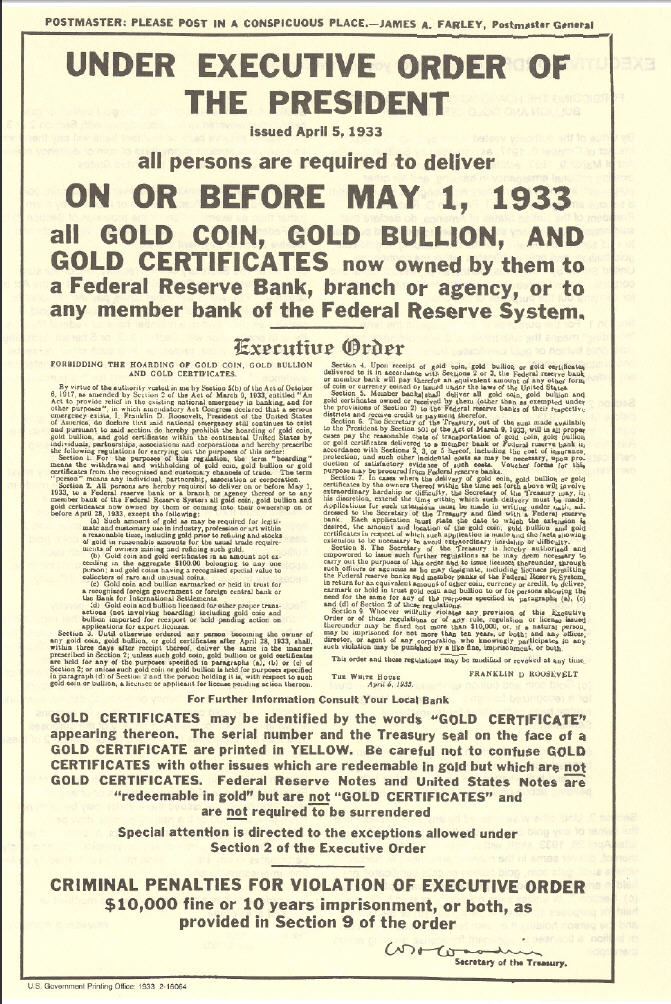
President Roosevelt passed Executive Order 6102 in 1933, making it illegal for individuals and corporations to “hoard” gold.
He justified the gold prohibition by saying that the hard times of the Great Depression had caused a hoarding problem, which slowed spending and inhibited the economic growth necessary to put the economy back on track. The prohibition making it illegal to own gold remained in place until 1974.
Public domain, via Wikimedia Commons
The U.S. government has more than $695 billion in gold reserve
According to the Department of the Treasury’s Bureau of the Fiscal Service, as of February 28, 2021, the U.S. government’s gold reserve totaled 261,498,926.241 fine troy ounces of gold (almost 9,000 tons), making the U.S. the country with the largest gold reserve in the world.
The vast majority of this reserve, approximately 258,641,878.085 fine troy ounces, is in the form of gold bullion. The total value of the U.S. government’s gold reserve is estimated to be about $695,587,143,801 as of October 2024, reflecting gold’s significant role in the nation’s financial stability.
The U.S. has more gold reserves than the 2nd, 3rd, and 4th ranked countries combined
As of the second quarter of 2024, the United States had the most gold reserves in the world, with approximately 8,133.46 tonnes. In addition to the U.S., other countries that made the top 10 include:
- U.S. – 8,133.46 tonnes
- Germany – 3,351.53 tonnes
- Italy – 2,451.84 tonnes
- France – 2,436.97 tonnes
- Russia – 2,355.85 tonnes
- China – 2,264.32 tonnes
- Japan – 845.97 tonnes
- India – 840.76 tonnes
- Netherlands – 612.45 tonnes
- Turkey – 584.93 tonnes
With 8,133.46 tonnes, the U.S. gold reserves dwarf Germany’s, Italy’s, and France’s combined total of 8,240.34 tonnes. That’s a lot of gold! In Asia, China leads the pack with 2,264.32 tonnes.

The majority of gold is used to make jewelry
Gold’s unique properties, including its malleability and the ability to alter its color, have made it an ideal material for jewelry-making throughout history.
According to the U.S. Geological Survey’s January 2024 Mineral Commodity Summaries, an estimated 46% of global gold consumption is dedicated to jewelry production, making it the most common use for this precious metal.
Gold is often alloyed with stronger metals to enhance its durability, as pure 24-karat gold is too soft for everyday wear. This combination of metals not only improves the strength of gold jewelry but also allows for a variety of colors, from classic yellow to white, rose, and even green gold, giving jewelers a versatile palette to work with.
In addition to being alloyed, gold is frequently used as plating on less expensive metals to create the appearance of solid gold without the associated cost. This technique makes gold jewelry more accessible to a broader range of consumers while still offering the aesthetic appeal and prestige of gold.
So, what else is gold used for?
Beyond jewelry, gold’s other uses include holdings by central banks and institutions (23%), physical bars (16%), official coins and medals (9%), electronics (5%), and other applications (1%), highlighting its diverse roles in both ornamental and practical applications worldwide.


Should I Invest in Gold Bullion or Gold Jewelry?
Deciding if you should invest in gold bullion or jewelry will require a lot of research. Here’s what you need to know.
Gold is used in countless products and industries
Gold’s unique properties make it invaluable across various industries, from electronics manufacturing and health care to aerospace engineering.
For instance, gold is often used in connectors, switches, and relay contacts due to its excellent conductivity and resistance to corrosion. These same qualities make gold an ideal material for aerospace applications, where it’s used to coat spacecraft and satellite components, protecting them from radiation and the harsh conditions of space.
In the health care sector, gold’s versatility extends to dental applications, where it’s commonly used in crowns and fillings due to its durability and biocompatibility. Historically, gold has been used as a treatment for rheumatoid arthritis, demonstrating its therapeutic potential.
This skull from the Nazca culture features gold teeth and a feather crown from birds brought from the Amazon. With more than 1600 years of antiquity it is in the Gold Museum of Peru and arms of the world.#archaeohistories pic.twitter.com/cSysIRptMa
— ArchaeoHistories (@histories_arch) May 11, 2022
Its resistance to tarnish and corrosion ensures that gold-based medical devices and treatments remain effective over long periods. This combination of durability, conductivity, and malleability helps to explain why gold is valuable beyond its traditional use in jewelry and is considered a critical resource in cutting-edge technology and medical advancements.
Some U.S. states still accept gold-infused currency notes
Goldbacks are a unique form of local currency made using .999 fine gold, created by spraying a thin layer of gold onto a polymer design and then covering it with more polymer. This currency was designed to restore the gold standard by providing a physical value to the money.
Although Goldbacks aren’t considered legal tender, some businesses in states like Utah, Wyoming, South Dakota, New Hampshire, and Nevada may accept them as such, each state having its own Goldback series.

Learn about Goldbacks price trends and what makes them so valuable.
Yes, you can eat some types of gold
Edible gold is a unique, decorative element often used to add a touch of luxury to food and drinks. Made from 23 to 24 karat gold, these ultra-thin sheets are specifically designed for consumption, though they don’t provide any nutritional benefits or alter the taste of the food.
Renaissance Raspberry Donut :: A sweet donut filled with raspberry jam and adorned with edible gold leaf, reflecting the artistry of the Renaissance. pic.twitter.com/rhEBijvuT6
— NeuroAutomata (@neuroautomata) May 25, 2024
Edible gold passes through the body undigested, serving no purpose other than enhancing the visual appeal of a dish, making it safe to eat. This makes edible gold a popular choice in high-end dining, where it’s used to create a sense of extravagance and exclusivity.
Gold cannot tarnish
If you’re wondering if gold can tarnish, the answer depends on the purity of the gold. One of the unique qualities of real gold is that it does not tarnish. This is because it doesn’t interact with oxygen, which means it cannot form rust or tarnish like other metals.
However, low-purity gold, which is often alloyed with other metals to increase strength and durability, can be susceptible to small amounts of tarnish over time. This tarnishing occurs because the non-gold metals in the alloy can react with oxygen or other environmental factors, though the gold itself remains untarnished.
Golden nuggets of knowledge: Fascinating facts about gold coins and bars
Gold coins and bars are rated based on their purity
Gold coins and bars are rated by their purity, typically measured as a percentage or decimal representing the amount of gold content, with 100% being pure gold.
As an investor, it’s important to always check if gold is real or being sold at the advertised purity before purchasing.
When referring to gold, it’s “karat” not “carat”
The terms “karat” and “carat” are often confused, but they refer to different measurements in the world of precious metals and gemstones.
“Karat” is used to describe the purity of gold, with 24 karats being the purest form, while “carat” measures the weight of gemstones, particularly diamonds, with one carat equal to 200 milligrams.
The purest gold coin is 99.999% pure gold
Gold fineness provides an even more precise measure of purity, expressed in parts per thousand. The Canadian Gold Maple Leaf coin, first introduced by the Royal Canadian Mint in 1979 under the vision of Walter Ott, has long been celebrated for its purity.
Initially minted with a gold purity of .999, the standard for these coins was elevated to .9999 pure gold over the years. However, in 2007, the Mint took gold purity to an unprecedented level by creating a special edition known as the “five-nines” coins, which boast an extraordinary .99999 purity—making them the purest gold coins in the world.
The Royal Canadian Mint released a limited number of “five-nines” Gold Maple Leaf Coins featuring this record-breaking 99.999% purity. The five-nines Gold Maple is occasionally re-released, but it’s usually sold at a hefty premium over spot price. This should come as no surprise, considering the coin’s historic purity and limited mintage!
These ultra-pure coins are not only a marvel of craftsmanship but also highly sought after, with prices ranging from $2.5 to $3 million.
The most expensive circulation gold coin sold for $18.87 million
The 1933 Saint-Gaudens Double Eagle holds a unique place in history as the last gold coin minted in the U.S. for use as currency. During its minting, gold was outlawed, leading to the melting down of most gold coins from that era.
However, 12 Double Eagles managed to escape this fate, making them incredibly rare and highly sought after by collectors and historians alike. Of the 12 coins that remain, only one of them is legal to own and sell, and in 2021, it sold for an astonishing $18.87 million at auction.
In June 2021, the 1933 Saint-Gaudens Double Eagle Gold Coin sold for a whopping $18.9 million, which makes it the most expensive coin ever sold at auction!
Only a handful of these coins survived after Congress ordered the U.S. Mint to melt them down, and most are illegal to own! pic.twitter.com/c1EyEE2dbG
— Hero Bullion (@HeroBullion) September 11, 2024
The battle to make the world’s largest gold coin
During the late 20th and early 21st centuries, multiple mints competed to make the biggest gold coin. The Perth Mint, the Austrian Mint, and the Royal Canadian Mint were the main contributors to this battle, all breaking records over the course of about 20 years. The eventual winner was the Perth Mint with its creation of the “1 Tonne Australian Kangaroo.”
The largest gold coin in the world is a 1 tonne Australian kangaroo. It has a face value of $1 million. pic.twitter.com/inotFnd1H0
— Historic Vids (@historyinmemes) March 30, 2024
Created to promote Australia’s official Kangaroo Gold Bullion Coin series and featuring an image of a kangaroo, the “1 Tonne Australian Kangaroo” officially became the world’s largest gold coin in 2012.
It weighs an astounding 2,231 pounds (1,012 kilograms) and measures 80 centimeters in diameter and 13 centimeters in thickness. It has a face value of $1 million AUD but is worth approximately $79 million USD based on the current spot price of gold.
Gold is easier to melt than most metals
Gold’s lower melting point of 1,064 °C (1,947.5 °F), compared to other metals like platinum, which melts at 1,768.3 °C (3,214.9 °F), makes it uniquely suited for minting coins. Its relatively low melting point allows for easier etching of intricate designs, contributing to gold’s longstanding use in creating detailed and beautiful coinage.
However, this malleability, while advantageous for crafting, also means that high-purity gold is more susceptible to damage and scratching. This delicate balance of beauty, rarity, and workability is why gold has been favored throughout history for coinage and fine artwork.
The world’s biggest gold bar weighs more than 550 pounds
Many people might be surprised to learn that the world’s largest gold bar actually weighs far less than the world’s largest gold coin. Weighing in at 550 pounds (250 kilograms), it was made by the Mitsubishi Materials Corporation in 2005 and is currently on display at the Tori Gold Museum in Izu, Japan. This massive bar has a melt value of approximately $21.2 million.

Reddit.com
You can search a gold bar’s serial number online
Gold bars typically come with a unique six-character serial number, which serves as a critical tool for identification and authentication. This serial number not only helps track the origin of the bar but also ensures its authenticity by linking it to its production details at the mint.
Fortunately, once you know how to check a gold bar’s serial number, you can often confirm the bar’s legitimacy by contacting the mint that produced it. The ability to search these serial numbers online adds an extra layer of security, making it easier for investors and collectors to verify the gold bar’s history and current location before purchasing it.
The value of gold investments: Yesterday and tomorrow
Silver was once more valuable than gold
At certain points in history, silver was considered more valuable than gold, a surprising contrast to the modern perception of these precious metals.
In Ancient Egypt, for example, historians believe that gold was abundant due to its proximity to Nubia, a region rich in gold deposits. This abundance made gold relatively common, while silver, which was much scarcer, was held in higher regard and value.
The mummy of king Tutankhamun was laid inside 3 coffins nested within each, with the innermost coffin made of 110.4 kg of solid gold. Collection: Egyptian Museum Cairo. pic.twitter.com/ncUAQbGzTG
— Archaeology & Art (@archaeologyart) August 27, 2023
Beyond Egypt, there are other instances where silver’s rarity outstripped gold’s value. William Ridgeway, in his work “The Origin of Metallic Currency and Weight Standards,” suggests that around the end of the 2nd millennium B.C., silver and gold were nearly equal in value across various parts of the ancient world.
However, by the 10th century B.C., significant silver deposits were discovered, particularly in Jerusalem, leading to a shift in the balance, where silver became more common, akin to “stones,” and thus less valuable than gold.
The highest and lowest gold-silver ratios ever
The gold-silver ratio (GSR) is a measure of how many ounces of silver are needed to trade for one ounce of gold, and it has fluctuated dramatically throughout history.
Some historians believe that in Ancient Egypt, the GSR dropped to as low as 2.5:1, marking the lowest recorded ratio in history due to the scarcity of silver compared to gold.
On the other end of the spectrum, the highest GSR ever occurred in April 2020 during the COVID-19 pandemic, when the ratio skyrocketed to 125:1, highlighting the extreme market conditions of that time.
Interestingly, some silver enthusiasts argue that the “appropriate” GSR should be 19:1, mirroring silver’s rarity relative to gold in the Earth’s crust. Using the gold-silver ratio is how some traders time their investments. This ongoing debate underscores the dynamic nature of the precious metals market and the factors that influence it.
Gold prices change by the minute
Gold prices are highly dynamic, changing by the minute based on various factors such as supply and demand, investor speculation, interest rates, geopolitical uncertainty, and inflation.
The spot price reflects the value of gold before accounting for premiums like processing and minting costs, meaning gold is rarely sold at this base price but can sometimes be found close to its melt value.
For buyers looking to make the most of their investment, it’s crucial to stay informed about the market’s current state and thoroughly research the best time to buy gold, as gold’s spot price can even fluctuate outside of regular market hours.

Is it Risky to Invest in Gold? | 2024 Gold Volatility Analysis
While gold is considered a risky, volatile short-term investment, it’s actually an excellent and consistent long-term investment asset.
Gold is a safe investment in times of crisis and uncertainty
Gold is often considered a safe haven asset, particularly during economic crises, due to its intrinsic value, rarity, and consistent demand. As a scarce resource, gold has the unique ability to protect your investment portfolio through diversification and by serving as a hedge against inflation.
In fact, historically speaking, gold has maintained or even increased in value during times of economic turmoil. For instance, during the COVID-19 pandemic from 2018 to 2020, gold prices saw a steady increase, peaking in late 2020, just months after the pandemic reached its most critical point. This resilience makes gold a reliable investment choice in uncertain economic times.
Investing in gold doesn’t have to break the bank
Investing in gold isn’t just a luxury reserved for the wealthy. There are many accessible ways to add gold to your portfolio without breaking the bank. While purchasing large gold bars or rare coins can be prohibitively expensive, there are more affordable options for those looking to buy gold for the first time, such as buying smaller amounts of gold or opting for paper gold investments.
Paper gold, like gold exchange-traded funds (ETFs), futures, and stocks, allows you to invest in gold without actually holding the physical metal, making it easier to buy, sell, and manage without the need for secure storage.
For those who prefer owning physical gold, the 1/10 oz backdate Gold Eagle offers an excellent entry point. Fractional gold pieces are smaller in size and weight than standard gold coins or bars (hence the name), making them more affordable for new investors.
Although fractional gold may come with higher premiums and a more limited selection, it allows you to gradually build your gold holdings over time.
New technologies have also made fractional gold even more accessible, with Goldbacks being a good example of this.
Whether you choose paper gold or physical gold, there are plenty of ways to start investing in this timeless asset without a substantial upfront cost.

Ready to start building your gold portfolio? Hero Bullion can help!
Investing in gold is an exciting journey, and Hero Bullion is here to guide you every step of the way. Whether you’re a seasoned investor or just starting out, it’s essential to do your research, compare options, and shop around at multiple dealers before making your first gold purchase.
Gold stacking isn’t just about accumulating wealth; it’s about appreciating the beauty and enduring value of gold, silver, and platinum.
At Hero Bullion, we share your passion for precious metals and are dedicated to helping you make informed decisions. Our team is always ready to answer any questions you may have, ensuring that your gold stacking experience is as rewarding as possible.
So, take the plunge, start stacking, and let us help you build a collection that not only secures your financial future but also brings you joy and satisfaction for years to come.


