
Which Canadian Coins Are Silver?

At a Glance:
- Pre-1968 Canadian dimes, quarters, halves, and dollars are silver.
- Circulating silver Canadian coins were 92.5% through 1919 and 80% through summer 1967.
- Canadian dimes and quarters were reduced from 80% to 50% midway through 1967, and they were changed from 50% to no-silver in August 1968.
- On this page, learn about which Canadian coins are silver, U.S. vs. Canadian junk silver, commemorative Canadian dollar purities, and more.
Which Canadian Coins Are Silver?
Pre-1968 Canadian dimes, quarters, 50-cent pieces, and dollars were made with real silver, with purities varying by era. These Canadian coins were 92.5% silver from 1858 until 1919 and became 80% silver from 1920 until 1967, with the exception of the five-cent piece, which was 80% silver from 1920-1921 and became non-silver in 1922.
Minted with 99.99% pure silver, the Canadian Silver Maple Leaf is Canada’s most recognizable silver coin. Canada’s annual commemorative silver dollar series began at a fineness of 50% in 1971, switching to 92.5% in 1992. Circulating loonies and toonies are not silver, but some collector versions of these coins are.
In the summer of 1967, dimes and quarters switched to 50% silver, while silver 50-cent and $1 pieces ceased production entirely. Halves and dollar coins dated 1967 are all still 80% silver, with the 1967 Canada Goose dollar being the final silver dollar produced in the country for circulation.
One year later, in August 1968, silver was removed from Canadian dimes and quarters. 1968 Canadian quarters and dimes can either be 50% or 0% silver, depending on when they were minted during the year.
Needless to say, figuring out which Canadian coins are silver can be tricky. On this page, learn which Canadian coins are silver, how much silver is in each Canadian coin, and more.

Canadian Silver Coins By Era: Sterling, 80%, and the 50% Transition
Silver in circulating Canadian coinage was gradually phased out beginning midway through 1967, with core denominations transitioning from 80% to 50% silver before losing their silver content entirely in August of 1968.
The highest purity circulating Canadian silver coins were minted from 1858 until 1919. These coins were 92.5% pure, also known as sterling silver.
Canadian Circulation Coins by Silver Content
| Coin | 1858–1919 | 1920–1966 | 1967 | 1968 | 1969–Today |
|---|---|---|---|---|---|
| 5 Cents | 92.5% | 80% (1920–21) None (1922 on) |
None | None | None |
| 10 Cents | 92.5% | 80% | 80% or 50% | 50% or None | None |
| 25 Cents | 92.5% (from 1870) | 80% | 80% or 50% | 50% or None | None |
| 50 Cents | 92.5% (from 1870) | 80% | 80% | None | None |
| $1 | — | 80% (from 1935) | 80% | None | None |
Source: Coin compositions sourced from Royal Canadian Mint specifications and the Standard Catalog of World Coins (Krause). Percentages refer to silver content.
The 1967-1968 Transition
Silver was phased out of Canadian coinage beginning in 1967, with the last remaining silver coins being struck midway through 1968. In the summer of 1967, 25-cent and 10-cent coins were reduced from 80% to 50% silver. One year later, in August of 1968, these coins were reduced to 0% silver content.
Canadian 50-cent and $1 coins contained 80% silver through 1967, at which point they were replaced by nickel versions in August 1968. The last circulating Canadian dollar made with real silver was the 1967 Canada Goose dollar.
How to Sort 1967 and 1968 Canadian Coins
| Coin | Possible Alloys | Magnetic? | Weight | How to Tell |
|---|---|---|---|---|
| 1967 10 Cents | 80% or 50% silver | No (both) | 2.33 g (both) | Magnet/scale don’t work. |
| 1967 25 Cents | 80% or 50% silver | No (both) | 5.83 g (both) | Magnet/scale don’t work. |
| 1967 50 Cents | 80% silver | No | 11.66 g | All silver |
| 1967 $1 | 80% silver | No | 23.33 g | All silver |
| 1968 10 Cents | 50% silver or nickel | Nickel: Yes | 2.33 g vs. 2.07 g | Magnet or scale |
| 1968 25 Cents | 50% silver or nickel | Nickel: Yes | 5.83 g vs. about 5.05 g | Magnet or scale |
| 1968 50 Cents | Nickel | Yes | 8.10 g | No silver |
| 1968 $1 | Nickel | Yes | Weighs less than silver $1 coins | No silver |
Source: Royal Canadian Mint specifications and the Standard Catalog of World Coins (Krause).
How Much Silver Is in Each Canadian Coin?
In the U.S. silver trade, $1 in face value is equal to 0.715 troy ounces of silver. This works because coin weights and purities were standardized across denominations for fungibility. In other words, one half dollar contains the same amount of silver as five dimes, and $1 in face value always contains the same amount of actual silver, regardless of the lot’s constituent denominations.
The same system holds true in Canada, but transitions between different purities throughout the 20th century complicate our equation. In Canada, “junk” silver content per $1 face breaks down like this:
- Until 1919: $1 in face value of 92.5% silver Canadian coins contained 0.691 troy ounces of silver.
- 1920-1967: $1 in face value of 80% silver coins contained 0.600 troy ounces of silver.
- 1967-1968: $1 in face value of 50% silver coins contained 0.375 troy ounces of silver.
Interestingly, the Canadian system for silver coin fungibility was actually more consistent than the American system, since the U.S. made an exception for its silver dollars. Canadian silver dollars followed the same weight convention used by other coins, so any combination of silver 5-cent, 10-cent, 25-cent, 50-cent, or $1 coins from the same era equals the same amount of silver per $1 face.
How Much Silver Is in Each Canadian Coin?
| Coin | Silver per $1 Face | Silver per Coin | Purity | Weight |
|---|---|---|---|---|
| 5 Cents (1858–1919) | 0.691 oz | 0.0346 oz | 92.5% | 1.16 g |
| 10 Cents (1858–1919) | 0.691 oz | 0.0691 oz | 92.5% | 2.32 g |
| 25 Cents (1870–1919) | 0.691 oz | 0.1728 oz | 92.5% | 5.81 g |
| 50 Cents (1870–1919) | 0.691 oz | 0.3456 oz | 92.5% | 11.62 g |
| 5 Cents (1920–1921) | 0.600 oz | 0.0300 oz | 80% | 1.17 g |
| 10 Cents (1920–1967) | 0.600 oz | 0.0600 oz | 80% | 2.33 g |
| 25 Cents (1920–1967) | 0.600 oz | 0.1500 oz | 80% | 5.83 g |
| 50 Cents (1920–1967) | 0.600 oz | 0.3000 oz | 80% | 11.66 g |
| $1 (1935–1967) | 0.600 oz | 0.6000 oz | 80% | 23.33 g |
| 10 Cents (1967–1968) | 0.375 oz | 0.0375 oz | 50% | 2.33 g |
| 25 Cents (1967–1968) | 0.375 oz | 0.0938 oz | 50% | 5.83 g |
| $1 Commemorative (1971–1991) | 0.375 oz | 0.3750 oz | 50% | 23.33 g |
Source: Royal Canadian Mint circulating coin specifications and the Standard Catalog of World Coins (Krause). Silver weight is in troy ounces.
Canadian vs. U.S. Junk Silver
U.S. dimes, quarters, and half dollars were minted with 90% pure silver until 1965. That year, silver dimes, and quarters were discontinued, while half dollars were reduced to 40% silver until the full removal of silver from U.S. halves in 1971.
By contrast, Canadian 5-, 10-, 25-, and 50-cent pieces began with a purity of 92.5% until being reduced to 80% pure in 1920. The 5-cent piece became non-silver in 1922, while 10- and 25-cent pieces were reduced from 80% to 50% beginning in summer 1967 until losing their silver content entirely in August of 1968. Canadian $1 coins were 80% silver for their entire run from 1935 until 1967; production of these coins and 50-cent pieces stopped in the summer of 1967.
Compared to American coinage, the Canadian coinage system’s journey from highly pure silver to no silver involved a series of gradual steps, rather than the single adjustment to most silver coins in 1965 experienced in the United States.
Despite purity differences, both U.S. junk 90% silver and circulated Canadian silver coins are valued the same way. Both products trade mostly on melt value, with coins of matching purities equaling a set amount of silver, regardless of which individual denominations are available in a lot.
Modern Canadian Silver Coins
Circulating Canadian coins are no longer minted with real silver, but the Royal Canadian Mint (RCM) produces a range of silver coins for investors and collectors. The mint’s flagship silver coin, the Canadian Silver Maple Leaf, is one of the world’s most popular silver bullion coins.
Aside from the Silver Maple, the RCM also produces commemorative silver dollars and various specialty silver coins for investors around the world.
Canadian Silver Maple Leaf
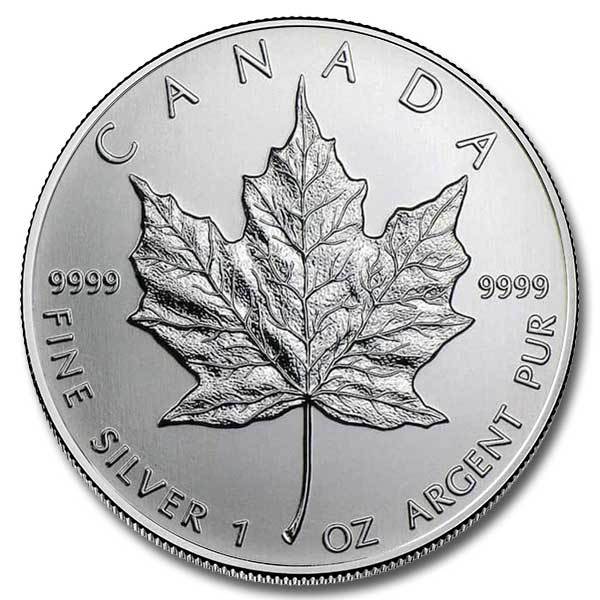
The Canadian Silver Maple Leaf is the Royal Canadian Mint’s flagship silver bullion coin and one of the world’s best-selling silver coins. Minted with a purity of 99.99%, it was also the first silver coin in the world to be minted with a fineness of .9999.
Canadian Silver Maple Leaf coins feature a face value of $5 CAD, but they’re not circulating and are not typically used as legal tender, since the silver a Silver Maple contains is worth considerably more than the coin’s stated denomination.
Commemorative Silver Dollars
Commemorative silver dollars are minted to celebrate major Canadian achievements, people, places, and cultural concepts. The first Canadian commemorative silver dollar was minted in 1935 to celebrate King George V’s Silver Jubilee.
Canadian commemorative dollars have varied in purity over the years, with fineness ranging from 50% during the 1970s and 1980s to the modern fineness of .9999 found on commemoratives dated 2012 and later.
How Pure Are Canadian Commemorative Silver Dollars?
Canadian silver dollars were 80% pure silver until 1967, when the Canada Goose dollar was the last .800 fine Canadian dollar. Production resumed from 1971 until 1991 with a reduced purity of 50% silver. Purity increased to 92.5% (sterling) in 1992, and again to 99.99% from 2012 on.
Here’s a brief overview of how pure Canadian silver commemorative dollars are by era:
- 1971-1991: 50% silver
- 1992-2011: 92.5% silver (sterling)
- 2012-Present: 99.99% silver
Collector Issues
The Royal Canadian Mint has also produced a number of collector issues to mark special occasions. The 1976 Montreal Olympic program is a great example of collector issues minted by the RCM. Each coin was struck in 92.5% silver, with the series running from 1973 until 1976 in the lead-up to the 1976 Montreal Olympics.
Modern Royal Canadian Mint collector coins are generally 99.99% silver. Unlike Canadian “junk” silver, collector coins do not adhere to a fixed silver content per $1 face value. If you’re buying a Canadian collector silver coin, you’ll need to look its weight and purity up individually.
Frequently Asked Questions About Canadian Silver Coins
Is a 1967 Canadian Quarter Silver?
Every 1967 Canadian quarter contains silver, but the amount depends on when the coin was minted. The Royal Canadian Mint lowered the purity of dimes and quarters from 80% to 50% in the summer of 1967. Both coins weigh the same, so the only way to tell which coin you have is to test the metal.
How Do I Tell if a 1968 Canadian Dime or Quarter Is Silver?
Some 1968 Canadian dimes and quarters are silver, but others aren’t, because the Royal Canadian Mint removed silver from circulating dimes and quarters in August of 1968. Weight can tell you the difference; silver Canadian dimes weigh 2.33 grams vs. 2.07 grams for the non-silver version, and silver Canadian quarters weigh 5.83 grams vs. 5.05 grams for the non-silver coin. The magnet test also works here. The silver coins won’t stick to a magnet, but the non-silver ones will.
How Much Silver Is in $1 Face of Canadian Coins?
From 1920 until 1966, $1 in face value of Canadian coins (80% silver each) contained exactly 0.600 troy oz of silver. Silver quarters and dimes minted with 50% silver beginning in summer 1967 until August 1968 added up to 0.375 troy oz per $1 face.
Are Canadian Dollars After 1967 Silver?
Circulating Canadian dollars minted in 1968 and later contain no silver. The last circulating Canadian silver dollar was the 1967 Canada Goose dollar. Collector dollars minted from 1971 on are silver; 50% from 1971-1991, 92.5% from 1992-2011, and 99.99% from 2012 until today. Certain coins, such as the 1971 collector dollar, were made with both a silver collector version and a nickel circulating strike. Use a magnet to tell these apart.
Is the 1921 Canadian Nickel Silver?
Canada’s 1921 five-cent pieces were struck in 80% silver, with a silver content of approximately 0.030 troy oz. These coins are extremely rare; nearly all of the 2.5 million struck were melted in favor of a pure nickel strike released on January 2, 1922. Only an estimated 400 survive, and it is often called “The Prince of Canadian Coins.”
Are Loonies or Toonies Silver?
No, circulating loonies and toonies are not silver. Collector versions of the coins have been minted and are typically sold by the Royal Canadian Mint as proofs inside of sets.
Final Thoughts: Which Canadian Coins Are Silver?
Canadian dimes, quarters, halves, and dollars minted prior to 1968 are silver, along with 50% dimes and quarters minted until August of 1968. Circulating Canadian coins dated 1969 or later are not.
There is approximately 0.600 troy oz of silver in $1 face value of 80% silver Canadian coins, regardless of the denomination mix. Certain edge cases, such as 1967 dimes or quarters that can be either 80% or 50% silver, can be tricky to appraise, since the magnet test won’t work for these.
For pure Canadian silver coins, modern Canadian Silver Maples (.9999 fine) and commemoratives dated 2012 and later (.9999 fine) are the way to go.
You might also be interested in:


About The Author

Michael Roets
With over six years of experience reporting on precious metals, Michael Roets covers market news, buying guides, and commentary for Hero Bullion.