
How to Spot a Fake American Gold Eagle (Specs, Tests, and Red Flags)

At a Glance:
-
- The American Gold Eagle is a common target for gold counterfeiters.
- The toughest counterfeits to spot use a tungsten core, which offers a similar density to gold.
- Modern Gold Eagles feature a “missing reed” on their edges, making it easier to spot fakes.
- Read more about how to spot a fake American Gold Eagle on this page.
How to Spot a Fake American Gold Eagle (Specs, Tests, and Red Flags)
The easiest way to spot a fake American Gold Eagle is to know the measurements of the real thing. A genuine 1 oz American Gold Eagle weighs 33.93 grams, has a diameter of 32.70 millimeters, and is non-magnetic. Checking both the magnetism and measurements (weight and diameter) of your coin will eliminate most counterfeits, which tend to fail at least one of these tests. Sophisticated tests can be used to test better fakes.
For decades, the American Gold Eagle has been one of the most popular gold coins in the world. Backed by the United States government, American Gold Eagles offer tight bid-ask spreads, an iconic set of designs, and durable 91.67% pure gold. But because of their liquidity and popularity, the Gold Eagle is also among the world’s most commonly counterfeited coins.
This guide will walk you through everything you need to know to identify a fake American Gold Eagle, including the real coin’s specifications, popular at-home gold tests, and more.
Avoiding Counterfeits: Securing Your American Gold Eagle Collection
The gold counterfeiting industry is worth an estimated $120 billion annually, and the American Gold Eagle is one of the most frequently faked gold products on the planet. It’s important for investors to stay vigilant, because falling for a fake can be a costly mistake.
To get a better idea of how to spot fake American Gold Eagles, let’s take a look at the genuine coin’s key specifications and security features.
American Gold Eagle Key Specs and Security Features
To verify the authenticity of your American Gold Eagle, you’ll need to know the coin’s regular specifications and security features. The United States Mint adheres to strict legal specifications when it produces American Gold Eagles, so each coin should deviate very little from its standard measurements.
Gold has a unique density compared to every other metal on earth. This means that an item with the same dimensions as a gold coin will have a different weight. A 1 oz American Gold Eagle should weigh 33.931 grams, have a diameter of 32.70 millimeters, and have a thickness of 2.87 millimeters.
Let’s take a closer look at the American Gold Eagle’s specifications.
American Gold Eagle Specifications
| Size | Face Value | Gold Content | Gross Weight | Diameter | Thickness |
|---|---|---|---|---|---|
| 1 oz | $50 | 1.0000 troy oz | 33.931 g | 32.70 mm | 2.87 mm |
| 1/2 oz | $25 | 0.5000 troy oz | 16.966 g | 27.00 mm | 2.24 mm |
| 1/4 oz | $10 | 0.2500 troy oz | 8.483 g | 22.00 mm | 1.83 mm |
| 1/10 oz | $5 | 0.1000 troy oz | 3.393 g | 16.50 mm | 1.19 mm |
All sizes are struck in 22-karat gold: 91.67% gold, 3% silver, balance copper, with a reeded edge.
This missing reed appears only on the full 1 oz American Gold Eagle and is not available on the coin’s fractional versions. To inspect for this security feature, carefully look at the edge of your American Gold Eagle. You’ll notice a series of notches surrounding the gold coin, but one should be missing. If your coin has the type 2 design and is not missing a reed, you could be dealing with a counterfeit.
Testing an American Gold Eagle: 5 Easy Home Tests
It is possible to test your American Gold Eagle at home in order to make sure you haven’t accidentally purchased a fake. While at-home tests are good for eliminating obvious fakes, they are seldom capable of confirming a genuine specimen.
Popular methods of testing an American Gold Eagle at home include:
- Weight and dimensions (size) test. Measuring an American Gold Eagle’s weight and dimensions can eliminate obvious fakes due to gold’s unique density, although sophisticated tungsten counterfeits with gold plating can match a Gold Eagle’s dimensions relatively well.
- Magnet test. Gold is not magnetic, so any American Gold Eagle that is attracted to a magnet is not made of real gold. This test can eliminate obvious fakes made with magnetic metals, but the test by itself does not confirm a Gold Eagle as legitimate, and fakes made with non-magnetic metals may pass.
- Ping/sound test. Gold coins make a unique sound when struck. Experienced gold investors can recognize this sound, which is unlike the sounds produced by other metals. The ping/sound test can tell investors if something is off about an American Gold Eagle, but it is not a conclusive gold test on its own.
- Visual detail inspection. Carefully inspecting the designs and details of an American Gold Eagle can help seasoned investors spot bad fakes. Sophisticated counterfeits can look almost exactly like the real thing, so this test alone rarely confirms an AGE’s authenticity and metal content.
- Edge and security feature check. American Gold Eagles minted after 2020 feature a missing reed on their edges. This security feature does not appear on type 1 American Gold Eagles, and sophisticated fakes can sometimes correctly replicate the missing reed on modern Gold Eagles. Additionally, the missing reed security feature only appears on the 1 oz American Gold Eagle, so this test does not work for fractional coins in the series.
Below, take a closer look at these popular methods of authenticating American Gold Eagles at home.

1. Weight and Dimensions (Size) Test
Every metal has a unique density. Because we know both the metal composition and the weight and dimensions of a standard American Gold Eagle, taking a measurement of your coin’s weight and dimensions can help you verify that you’re not dealing with an obvious fake.
To do the weight and dimensions test on your American Gold Eagle, carefully measure your coin’s diameter, thickness, and weight. For the 1 oz American Gold Eagle, your coin should weigh 33.931 grams, have a diameter of 32.70 millimeters, and have a thickness of 2.87 millimeters. While small dimension errors are possible, you should view any coin with a large deviation as very suspicious.
What it catches:
The weight and dimensions test is great at spotting bad fakes. If a scammer has used a metal with a radically different density than gold for their counterfeit, comparing your coin’s weight and dimensions against the specs of an actual American Gold Eagle should immediately reveal the difference.
What it misses:
Although each metal has a unique density, some metals are so similar in density that a standard scale may not spot the difference. Sophisticated counterfeiters also use complex alloys to carefully match the specifications of a genuine American Gold Eagle.
Fakes made using a tungsten core and gold plating are especially difficult to confirm using the weight and dimensions test. Tungsten has a very similar density to gold, and a thin layer of gold plating can trick even experienced investors who measure their Gold Eagles against U.S. Mint standards.
Bottom line: The weight and dimensions test is reliable for identifying bad fakes, but this test cannot definitively rule out more sophisticated counterfeits.

2. Magnet Test
The metals (gold, silver, and copper) that compose the American Gold Eagle are not attracted by magnets, making the magnet test an easy way for investors to eliminate obvious fakes.
To test a Gold Eagle using a magnet, hold the magnet close to the coin. A Gold Eagle that is attracted to or pulled by the magnet is not made of real gold.
Some investors mistakenly believe that a genuine American Gold Eagle won’t react at all to a magnet’s presence. This is untrue. A genuine gold coin produces eddy currents, a phenomenon that causes the coin to be slightly repelled by a magnet. That’s why the magnet slide test works; actual American Gold Eagles should slide slowly down an angled magnetic surface, while non-gold coins will fall more quickly.
To do a magnet slide test, slide the coin down a steeply angled strong magnet. If your coin is real, it should fall slightly slowly down the surface. Fake gold coins fall more quickly.
What it catches:
Obvious fakes using magnetic metals will cling to the magnet, making it easy to eliminate the laziest counterfeits using the magnet test.
What it misses:
The magnet test has two notable downsides that investors often miss.
First, plenty of metals other than gold are non-magnetic. A gold-plated counterfeit made of a cheap non-magnetic metal may pass the magnet test, even though it’s not made from pure gold.
Second, the magnet test only tells investors whether their coin is made from a metal other than gold. It does not confirm that an American Gold Eagle is legitimate. While Gold Eagle counterfeits made with real gold are seldom profitable for scammers, counterfeiters may sometimes make genuine gold fakes of rare or valuable editions of the American Gold Eagle.

3. Ping/Sound Test
The ping test is a favorite among seasoned gold stackers.
When tapped by a solid object, the ‘ping’ sound that a gold coin generates has a unique frequency. Experienced investors can learn to identify this sound, which is different than coins made from cheaper metals.
To do the ping test, hold your coin loosely and strike it gently on its edge with a non-metal object. If your coin is made of precious metals, you should hear a high-pitched and long ringing noise. Base metals and other bad fakes produce a duller, shorter “thud” sound.
While this test can help experienced investors quickly verify the precious metal content of their coin, it is not recommended for coins in great condition. Brilliant Uncirculated (BU) coins can lose value if your ping testing leads to small dents or scratches.
What it catches:
If you know what a correct gold “ping” sounds like, the ping test can quickly eliminate bad fakes from your collection.
What it misses:
The ping test is not especially reliable, and inexperienced or new gold stackers may not be able to confidently differentiate between the ping sound of a gold coin and the sound generated by tapping other metals.
While doing the ping test is a quick way to eliminate bad fakes, it’s a poor test to rely on and should be paired with other tests before you conclude that your American Gold Eagle is legitimate.
4. Visual Detail Inspection
For collectors who own several American Gold Eagles, a detailed visual inspection can also be a reliable way to test coins. While some especially bad fakes can be identified with the naked eye, many investors prefer to look at their coins under magnification to get a better view.
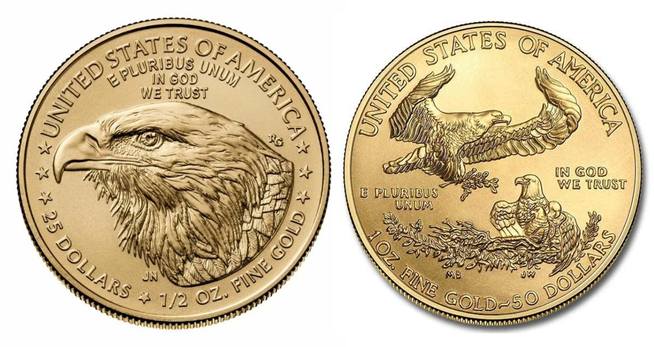
Be sure to look at the highly detailed parts of the coin that can be difficult to reproduce, such as Lady Liberty’s facial features, the lettering on inscriptions, and the eagle portrait on the reverse side of modern Type 2 Gold Eagles.
To visually inspect your American Gold Eagles, compare the features of your coins to examples published by the United States Mint. If anything looks suspicious, that’s your cue to look closer.
What it catches:
Like some of the other tests on this list, visual inspection primarily catches the most obvious fakes.
However, noticing something that looks strange upon visual inspection can tip you off to investigate further. If your coin looks different than the images published by the official U.S. Mint website, it may be time to do some more testing to make sure you’re not dealing with a counterfeit.
What it misses:
Visual detail inspection won’t always identify fake American Gold Eagles. Some sophisticated fakes look quite similar to the real Gold Eagle, and you might not be able to tell the difference unless you’ve looked at hundreds of American Gold Eagles.
This method of testing an American Gold Eagle also only verifies that a coin looks right. A counterfeit American Gold Eagle might look identical to the real thing but feature cheap base metals beneath the surface. This is why you should conduct multiple tests before verifying that your American Gold Eagles are legitimate.

5. Edge and Security Feature Check
Checking for a missing reed may be the single easiest way to spot a counterfeit American Gold Eagle. Since the release of the Type 2 Gold Eagle in mid-2021, all 1 oz American Gold Eagles have featured a missing reed. Reeds are the notch-like marks surrounding the edge of a coin.
To inspect for a missing reed, rotate your American Gold Eagle along its edge. One of the reeds should be missing, creating a smooth gap in the coin’s edge reeds. The U.S. Mint does not publish the location of these missing reeds in an effort to deter counterfeiters, but most precious metal dealers know the location of the latest year’s missing reed.
If your type 2 American Gold Eagle has all of its reeds, you may be dealing with a fake.
What it catches:
Since the U.S. Mint only began including missing reeds as a security feature in 2021, this feature is rather new, so some counterfeiters may not include it on their fakes. Additionally, replicating the reeding on a gold coin is already difficult for counterfeiting operations, and the missing reed makes it even more difficult for fakers to match the U.S. Mint’s work.
What it misses:
Checking for a missing reed to verify your American Gold Eagle can fall short in two ways.
- Only Type 2 Gold Eagles feature a missing reed, so this test does not work for older American Gold Eagles.
- The missing reed security feature only appears on 1 oz Gold Eagles, which means that it won’t work for testing fractional (1/10 oz, 1/4 oz, 1/2 oz) American Gold Eagle coins.
If your coin is one of the American Gold Eagles that features a missing reed, this security feature can help you weed out obvious fakes.
Red Flags: Watch Out For These Fake Gold Eagle Tells
Spotting a fake American Gold Eagle is possible through at-home testing, but the best way to avoid scams is to look for red flags during the buying process.
The most common red flag for a counterfeit coin is a price that’s too good to be true. The truth is that nobody is going to sell you a 1 oz American Gold Eagle for half off spot price. When a deal is that good, you’re likely looking at a counterfeit coin.
Poor trust signals from your seller can also suggest that a counterfeit is possible. Some signs that you’re dealing with an untrustworthy dealer include:
- Unverifiable reviews. Look for reviews sourced from verified customers and curated by respected customer testimonial companies.
- Extremely limited or overly complicated payment methods. Dealers asking for payment in limited options like cash apps, crypto or other methods that are irreversible or offer little buyer protection are sending you a signal that they may not be trustworthy.
- High pressure sales tactics. Ticking clocks on deals, aggressive pop-ups or email marketing, and other high-pressure tactics are sometimes used by scammers to trick consumers into quickly buying their counterfeit gold products.
Any one of these signals could be a reason to walk away from a deal.
Tungsten: A Gold Counterfeiter’s Greatest Tool
Tungsten is a high-quality counterfeiter’s best friend.
Tungsten has a density of 19.25 grams per centimeter cubed, compared to gold’s 19.30 g/cm³, giving tungsten approximately 99.7% of gold’s density. This makes it perfect for counterfeiters producing fake American Gold Eagles intended to pass weight and dimension tests. While brass is the most commonly used metal to counterfeit gold, sophisticated operations use tungsten for larger and more valuable gold products because of its remarkably similar density to gold.
On the bright side, tungsten is difficult to work with. We typically see tungsten fakes in large, highly valuable gold products, and it’s an uncommon counterfeit tool for smaller gold coins.
Because a tungsten fake can come close to the weight and size of a genuine American Gold Eagle, measurements alone won’t always catch one. The reliable way to rule out a counterfeit is an electronic tester like a Sigma, which reads for metal beneath the plating.
Frequently Asked Questions About Identifying Fake Gold Eagles
How Much Does a Real 1 oz American Gold Eagle Weigh?
A genuine American Gold Eagle weighs 33.931 grams, or 1.0909 troy ounces, and contains a full troy ounce of gold.
Are American Gold Eagles Magnetic?
American Gold Eagles are not attracted to magnets. Gold Eagle coins that are pulled by magnets are likely counterfeits, although the effects of eddy currents can cause genuine gold coins to be slightly repelled by strong magnetic forces.
Can a Fake Gold Eagle Pass the Weight and Size Test?
A simple tungsten counterfeit usually fails the test on either weight or size, but a sophisticated tungsten fake American Gold Eagle can come close on both. This is why measurements alone aren’t usually enough. We recommend following up with an electronic conductivity test, such as a Sigma, if you’re unsure whether your Gold Eagle is legit.
Is the American Gold Eagle Pure Gold?
The American Gold Eagle is made using 22 karat gold (91.67% pure).
How Can I Tell a Type 1 From a Type 2 Gold Eagle?
You can tell the difference between a type 1 and type 2 American Gold Eagle by checking its designs. The type 1 Gold Eagle features an action scene of a family of bald eagles designed by Miley Busiek. Jennie Norris designed the type 2 American Gold Eagle, which depicts a close-up shot of a bald eagle.
The type 1 to type 2 design change happened in mid-2021. American Gold Eagles minted in 2022 or later are always type 2.
Does the Ping Test Work on American Gold Eagle Coins?
Yes, the ping test works on American Gold Eagle coins. When struck with a nonmetal object, a Gold Eagle should produce a lingering, high-pitched ring. Coins made without either gold or silver produce duller, shorter thud-like sounds.
What Should I Do if I Think I Bought a Fake American Gold Eagle?
If you think you’ve purchased a fake American Gold Eagle, you have a few options. If you did business with a reputable dealer, reach out to the company’s customer service team. Contact a local dealer you trust for a second opinion or a Sigma tester evaluation of the suspected counterfeit. If the coin you purchased is confirmed fake, contact your payment processor to see if a refund is possible and report the company.
Are Graded (Slabbed) Gold Eagles Safe From Counterfeits?
Certified American Gold Eagles are almost never counterfeited, provided that the certification itself is legitimate and was conducted by a reputable grading company like PCGS or NGC. While a fake could theoretically be certified, these coin grading companies very rarely make such a large mistake. Make sure to confirm the authenticity of your slabbed Gold Eagle, but don’t break it out of the slab for testing unless you are confident that the certification was forged. Most modern grading companies allow investors to search certification numbers online, so you can use this number on your slabbed coin to make sure the certification is legitimate.
Final Thoughts: How to Spot a Fake American Gold Eagle:
Fake American Gold Eagles are unfortunately a major problem in the gold investment market. Counterfeits are becoming more and more sophisticated, so it’s important for investors to learn how to spot a fake from the real thing.
You might also be interested in:


About The Author

Michael Roets
With over six years of experience reporting on precious metals, Michael Roets covers market news, buying guides, and commentary for Hero Bullion.