
Where Did Monster Boxes Get Their Name?

At a Glance:
-
- Monster boxes are large boxes of bullion coins, usually sold in quantities of 250 or 500.
- Buying a monster box is a significant, but rewarding, way to invest in silver or gold.
- The original monster box was likely created by the U.S. Mint in 1986.
- On this page, learn with us as we explore the origins of the monster box – and its name.
How Did Monster Boxes Get Their Name?
For many stackers, owning a monster box is a lifelong dream. Monster boxes are large plastic containers filled with either 250 or 500 silver or gold coins, depending on which coins you choose to buy. Because of how many 1 oz silver coins are contained in a monster box, they’re exceptionally expensive to purchase.
However, investors willing to spend the extra money can take advantage of excellent pricing by buying monster boxes. Because monster boxes are functionally bulk lots of silver coins, you’ll typically pay a lower premium per coin buying a monster box compared to what you’d pay if you purchased the same coins individually.
But one of the questions we sometimes receive about monster boxes doesn’t have anything to do with their investment potential. Why are monster boxes called that? The available evidence suggests that the term ‘monster box’ was coined by the U.S. Mint in 1986 in order to promote large purchases of American Silver Eagles.
On this page, we’re taking a deep dive into the history, origin, and the name behind one of the most iconic ways to invest in silver.
What is a Monster Box?
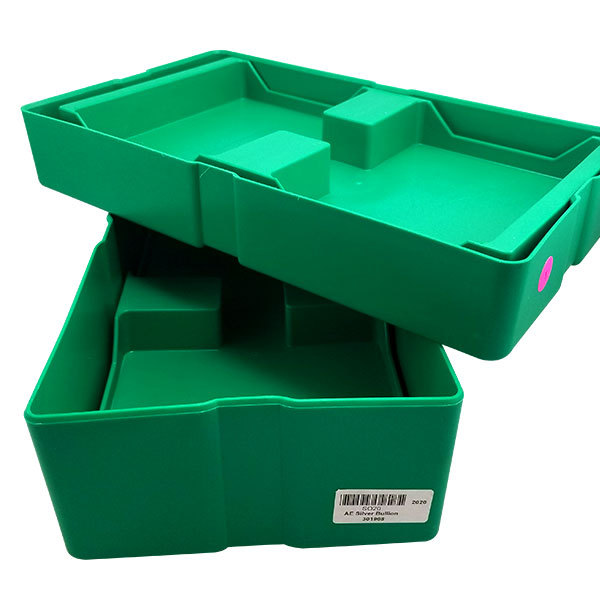
Monster boxes are large, sturdy plastic containers filled with coins. The most popular monster boxes include silver coins, since the price of 500 gold coins would typically be prohibitively high for the average investor to afford. The number of silver coins contained in a monster box depends on which coin you decide to purchase:
- American Silver Eagles – 500 coins.
- Canadian Silver Maples – 500 coins.
- Austrian Silver Philharmonics – 500 coins.
- British Silver Britannias – 500 coins.
- Australian Silver Kangaroos – 250 coins.
- South African Silver Krugerrands – 500 coins.
Monster boxes themselves have become somewhat iconic among silver stackers. Many companies sell empty monster boxes, which investors can slowly fill up with coins of their choosing over time. Although monster boxes are widely considered an innovation by the United States Mint, most of the world’s sovereign mints now sell monster boxes filled with their flagship products.
Who Invented Monster Boxes?
Nearly every government mint on the planet now produces monster boxes, but where did the idea come from? According to most industry experts, the first true monster box was released by the United States Mint along with the American Silver Eagle in 1986.
This may seem strange, but it’s important to remember that modern bullion coinage doesn’t really go much further back than 1986. The Mexican Silver Libertad is widely considered the world’s first modern silver bullion coin. That is, the Silver Libertad was the first highly pure silver coin intended specially for investors.
The popularity of the Mexican Silver Libertad led to the release of several other silver coins, including the American Silver Eagle, the Canadian Silver Maple, and the British Silver Britannia. But for the monster box, history truly begins at the U.S. Mint.

Origins | Why Are Monster Boxes Called That?
So, how did monster boxes get their name? Unfortunately, there are no official U.S. Mint documents confirming the origins of the “monster box” term. That being said, there are a couple different reasons why the U.S. Mint began calling these large American Silver Eagle shipments monster boxes:
- To describe the massive nature of the investment.
- As a marketing technique to promote the product.
A Monster-Sized Investment
The most likely reason monster boxes are called monster boxes is their large size. Both in the United States and abroad, the term “monster” implies a kind of large, hulking, intimidating beast. The designers of the first American Silver Eagle Monster Box may have thought that the word “monster” perfectly describes the size and scale of a monster box investment.
Describing large objects as monsters is also a common American expression. If someone sees a massive hamburger, for example, you may hear them say, “wow, look at that monster!” In this respect, it makes sense that the U.S. Mint might have used the phrase to describe what was – and still is – its largest option for standard bullion investments.
And just between us, we wouldn’t have it any other way. Monster boxes are iconic for precisely this reason – they’re insanely large. “Bulk American Silver Eagles” simply wouldn’t have the same ring to it!

A Popular Marketing Technique
There’s another reason why monster boxes probably got their name, though. Any good business owner knows that marketing is essential, and the U.S. Mint puts quite a bit of effort into branding and name recognition. While the U.S. Mint today is known as one of the world’s leading producers of gold and silver bullion products, remember that bullion coins meant for average investors were still rather new in the 1980s.
The term “monster box” has a fantastic ring to it. The phrase is instantly recognizable and very unique. As a result, people remember the product name once they hear about it for the first time. It seems very likely that at least part of the motivation for naming these packages monster boxes was to make them easier to remember and market to investors.
Again, imagine what it would be like if the U.S. Mint chose to call monster boxes something less recognizable, like “big boxes.” Would investors have the same obsession for “big boxes” as they do for the iconic monster box? Maybe, but probably not.
Final Thoughts: Here’s Why Monster Boxes Are Called Monster Boxes (Probably)
There we have it! It’s unfortunate that we don’t have more historical sources about where monster boxes got their name. But for now, it seems most likely that the term monster box served a dual-function for the U.S. Mint when it (most likely) coined the term in 1986. First, the phrase accurately describes the enormity of the investment, which is one of the most costly methods of buying American Silver Eagles. Second, its uniqueness and recognizability were major marketing boons for the United States Mint.
Whatever the origin, the monster box name has stuck. Mints around the world produce monster boxes for their most popular products, and the term has become synonymous with one of the most coveted products in bullion. Whether you’re buying an empty monster box to store your collection or a full one to expand your precious metal portfolio, you’re buying one of the most exciting – and rewarding – products in the precious metals industry.
You might also be interested in:


About The Author

Michael Roets
With over six years of experience reporting on precious metals, Michael Roets covers market news, buying guides, and commentary for Hero Bullion.