
What Are Mint-Made Error Coins?

At a Glance:
-
- Mint-made error coins are coins that feature a visible mistake made by their manufacturer.
- Some error coins are common, but others are both rare and very valuable.
- Errors can happen during any step in the minting process. Learn more on this page.
What Are Mint-Made Error Coins – And Are They Valuable?
In most industries, products are valued based on their perfection. Nobody would ever pay more for a broken hairbrush than a flawless, working one. Although some new collectors may find it hard to believe, the opposite is often true within the world of rare coins. That’s right – certain United States coins are actually worth more if they contain errors!
For beginning numismatists, it is important to qualify what we mean when we talk about errors. Coins that have been damaged by collectors or investors are not valuable and do not count as error coins. The term error coin refers to coins that contain mint-made errors, which are mistakes made by the manufacturer of the coin during its production process.
What are mint-made error coins? Mint-error coins are coins that feature mistakes committed by the mint that produced them. These errors can come in many forms, including:
- Planchet Errors. Planchet errors occur while a mint is producing the planchet, which is the round metallic disk that a coin’s design is struck onto. Planchet errors most often affect the shape of a coin.
- Die Errors. Die errors happen to a coin’s die, which is a thick metallic disk used to strike a design onto each coin. Die errors often impact the appearance of a coin’s design.
- Strike Errors. A strike error occurs during one of the last parts of the minting process, when a planchet is struck by a die. Strike errors can come in many forms and often change a coin’s shape, appearance, or both.
Some rare error coins are extremely valuable to collectors. On this page, we’ll cover everything new numismatists should know about mint-made error coins – and how to spot these errors on your own coins.
What is a Mint-Made Error Coin?
What counts as a mint-made error coin? Simply put, mint-made error coins are coins that feature visible mistakes that happen during a government’s minting process of a coin. Because governments are motivated to make their minting processes as efficient as possible, genuine mint-made error coins are usually pretty rare.
Mint-made error coins are popular among numismatists, collectors who study rare coins and other forms of money. In a sense, the numismatic coin industry is one of the few sectors where a product’s value can increase when it features a production error!
Mint-made error coins come in many forms. Let’s take a look at the different types of mint-made error coins.
Types of Mint-Made Errors
There are many different types of mint-made errors that can appear on coins, and we don’t have time to talk about all of them in this guide. However, most mint-made errors happen during one of three stages in the minting process:
- Planchet Production
- Die Production
- Striking Process
Below, we’ll take a closer look at each of these error categories, as well as some of the most common errors we see during each step of the minting process.
Planchet Errors
To make a coin, mints start by producing a planchet. Planchets are plain, thin disks of metal that resemble designless coins. To make a coin’s planchet, mints cut circular disks out of a much larger strip or coil of metal. Sometimes, the machine responsible for cutting the planchet out of the strip of metal malfunctions, leaving the would-be coin with an irregular shape.
Clipped planchets, lamination flaws, and a few other errors often happen during the planchet production stage of the minting process.
Clipped Planchets
What is a clipped planchet error? Clipped planchet mint-made errors usually happen while the thin strip of metal is being fed through the blanking machine. Most of the time, the blanking machine cuts several different small circular disks out of the strip, creating perfectly circular rounds that are then struck with a die to become coins.
When a clipped planchet occurs, it is because the blanking machine’s punches overlap the boundaries of two separate blanks. The result is a clipped planchet. What do clipped planchets look like? While a clipped planchet mint-made error coin can vary in obviousness, these coins usually look like a chunk has been taken out of part of them.

Lamination Flaws
Lamination errors can also occur during the planchet production part of the minting process. Interestingly enough, a lamination error may not be immediately evident once a coin is minted. Over time, coins with lamination flaws begin to peel or crack.
Metallurgists aren’t quite sure why lamination flaws happen, but most believe that this error results from a planchet’s alloy(s) being contaminated. What does a lamination error coin look like? Most lamination error coins feature what looks to be a crack on their surfaces. In reality, this crack is actually the coin peeling or splitting along its horizontal axis.

Other Planchet Error Types
There are many things that can go wrong during the planchet production stage of the minting process. We don’t have time to run through them all in this guide, but here are a few examples of the different types of planchet errors that researchers have observed:
- Blank Planchets. This occurs when the die misses a coin’s planchet entirely.
- Split Planchets. Split planchet error coins have split entirely down the middle during the minting process and are identified by a design on one side and a rough, textured metallic design on the other.
- Cladding Flaws. Coins with cladding flaws are usually missing part of the outer layer of metal that gives them their characteristic appearance.
Die Errors
Die errors are likely the most common mint-made errors encountered by coin collectors. Quite a lot can go wrong with a coin’s die, which is a thick chunk of metal used to strike the mint’s desired design onto coins.
Many die errors are explained by equipment malfunction. According to the United States Mint, a single penny die can be used to strike around 1,000,000 pennies! A dime die can only strike around 275,000 coins – but that’s still quite a lot! After so many strikes, dies can malfunction or become worn down, resulting in die errors.
Most mint-made die error coins fall into three main categories:
- Doubled Dies.
- Overdates.
- Misaligned Dies.
Doubled Dies
Doubled dies are one of the most recognizable mint-made errors you’ll find on U.S. circulation coins. The most famous (and valuable) doubled die coins feature very dramatic doubling effects, but other doubled die coins are much subtler.
What causes a doubled die coin? Doubled die coins refer to coins that have been struck twice by their die instead of just once. These coins can vary in appearance. Most of the time, a doubled die coin will look like one of its designs has a shadow. The obviousness of the effect, also called its ‘spectacularness’, is used to describe the type of doubled die a coin has.
Some doubled die mint-made error coins are so subtle that you might need to use a magnifying glass to find the error.

Overdates
An overdate is another mint-made error coin that can occur during the die process of a coin’s production. Mints will occasionally strike another year onto a coin’s existing date mark, resulting in a rare coin error known as an overdate. The 1918 Buffalo Nickel is one example of this error. Certain strikes of this coin feature the “8 over 7” overdate error. When the U.S. Mint produced these coins, they accidentally used the previous year’s date (1917) and then struck it once more with the newer 1918 date.
Overdates are sometimes called varieties instead of errors, because the U.S. mint has occasionally used overdating in order to speed-up the minting process when producing the newest year of a coin.
What does an overdate error coin look like? Overdates can be tricky to spot. Seasoned numismatists verify overdate coins by referencing them against non-error coins from the same error. On the 8-over-7 Buffalo Nickel, for example, close examination reveals that the top of the number 8 appears flatter than it should be because of the 7 underneath it.

Misaligned Dies
What is a misaligned die error? On a misaligned die mint-made error coin, one of the two dies used to strike a coin with its obverse and reverse designs is off-centered – either by a little or a lot. The result? One side of the coin is off-center, but the other is perfect.
Misaligned die errors are sometimes mistaken for planchet errors. When the planchet is improperly centered during the minting process, both sides of the coin will be off-center. On a misaligned die mint-made error coin, the planchet is firmly in place but the die is misaligned. This results in only one side of the coin being off-center.
Strike Errors
Striking is the last part of the process used to create circulation currency coins. Striking is the process of pushing a die into a planchet using an extreme amount of force, giving the coin a design on both sides.
Strike errors are different from planchet or die errors because they are the result of a manufacturing issue – not a problem with either the die or the planchet.
Strike errors usually come in three main types:
- Die Caps
- Brockages
- Off Center Strikes
Die Caps
Die cap mint-made error coins happen when one of the coins being struck by a die sticks to it. Over time, this stuck coin strikes many other coins. If enough coins are struck by the coin stuck to the die, these coins eventually take a different shape.
What do die cap error coins look like? A die cap coin will be shaped more like a bottle cap than a traditional coin. The coin stuck to the die pushes down on the center of a coin, bending its edges until it develops the characteristic ‘die cap’ shape.
Brockages
Brockage errors also result from a coin becoming stuck to the die striking it. The difference between a brokerage and a die cap error is that a brockage error happens when the stuck coin has already been imprinted with its design. The result of the brokerage error is one of the most interesting and sought-after mint-made errors in numismatics.
What is a brockage coin – and what does it look like? Brockage error coins are coins that have been struck by an already-minted coin that has become stuck to its die. A brockage coin will feature the imprint of another coin on top of it. Brockages can look radically different, depending on how a coin’s particular brockage occurred.
On some coins, the second design imprint may be very clear. Other coins featuring the brockage mint-made error can be much more difficult to spot. Numismatists may need to use a high-power magnifying lens to verify the brockage error on a given coin.
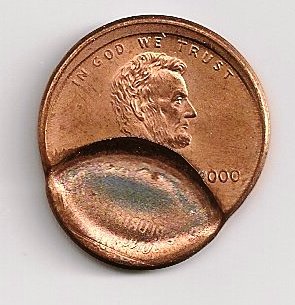
Off Center Strikes
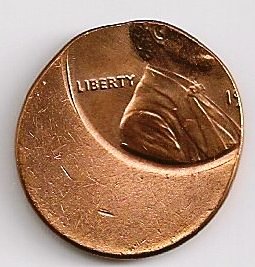
Off-center strikes happen when a planchet is improperly centered while the coin is being struck by the die. Off-center strike error coins are very popular among collectors because of their strange appearance.
An off-center strike mint-error coin will usually appear misshapen and will be missing at least part of its design on both sides. Off-center strikes are often confused with misaligned die error coins. Remember the difference – off-center strike coins will be misaligned on both sides, but a misaligned die error coin looks strange on only one side.
How to Spot a Mint-Made Error Coin
The best way to spot a mint-made error coin is to look at the coin closely under a specialized magnifying tool called a loupe. Some errors are almost impossible to spot with the naked eye. Comparing your suspected error coin to a normal version of the same coin series is a good way to verify that it features an error.
Expert consultation can also be an excellent way to find out if your investment is a genuine mint-made error. Coin grading services and numismatic organizations can help evaluate a coin’s appearance and prove its error coin status.
What Mint-Made Error Coins Are Worth Money?
Collecting mint-made error coins is one of the most popular hobbies among numismatists. Throughout the history of the United States Mint, there have been thousands of different errors known to occur during the minting process.
Because of the sheer quantity of error coins out there, your best bet for figuring out which error coins are worth money is to consult a coin catalog. Many coin catalogs will provide readers with examples of nearly every discovered mint-made error found on a given coin series.
How to Value U.S. Error Coins
Not all U.S. error coins are valuable. Certain coin series are minted in such high quantities that nearly every error is very common. Take the United States penny, for example. The United States Mint produced billions of pennies in 2019. Because of how many pennies the mint made, it’s fair to assume that a high number of errors occurred.
Other error coins are far rarer. Rarity is not the only thing that makes error coins valuable. What makes an error coin worth money?
Error coins are generally valued based on three main factors:
- Rarity. How many known specimens of that particular error are known to exist?
- Popularity. Is the coin featuring this error popular among collectors? Does the error belong to a series of coins frequently collected by investors?
- Spectacularness. How obvious is the error? Is it visible with the naked eye? Does the error add to the visual appeal of the coin?
Rarity
Rarity is a major part of what makes mint-made error coins valuable. Certain errors are very common and are not worth very much money. During certain minting years, the U.S. Mint may make more “error” coins of a given series than normal coins.
The rarest mint-made errors are either one-of-a-kind or come from extremely limited minting runs. If a coin is already rare and produced in small quantities, it makes sense that error coins from that minting run would be even more rare and valuable to collectors.
Popularity
Even if an error is relatively common, it might be valuable if it is popular among collectors. Each coin collector has his or her own preferences and favorite coins. Certain error coins are very popular among collectors and may be valuable – even if they are easy to find.
Frequenting coin collector websites, magazines, and forums is a good way to get a feel for how popular certain rare mint-made error coins are.
“Spectacularness”
Spectacularness is another factor that determines how valuable a mint-made error coin might be. The term spectacularness refers to how obvious and interesting a coin’s error is. Certain errors might actually enhance the appearance of a coin or make it more fun to look at. Other errors are spectacularly ugly, but the coin’s error is so obvious that collectors can’t help but to try to get their hands on it.
The more spectacular a coin’s error is, the more you can expect it to be worth to investors and collectors.
Variety or Error – A Classic Debate Among Numismatists
We’ll leave you with a brief taste of an ongoing debate among coin collectors. Some coins may appear to be errors but are actually varieties. A variety refers to a minor alteration to a given coin’s appearance. Usually, there are many different specimens of every variety in a minting run.
Varieties can be intentional, but errors are not. For a coin’s features to constitute an error, it needs to include an accidental oversight or mistake on the part of a mint.
Numismatists often debate about whether or not a particular coin counts as a variety or as an error. The difference in definitions may seem clear, but the application of these definitions is a different matter entirely.


About The Author

Michael Roets
With over six years of experience reporting on precious metals, Michael Roets covers market news, buying guides, and commentary for Hero Bullion.