
How Much Silver is in a US Coin? | Complete Guide to Circulating Coin Silver Content

At a Glance:
-
- Circulating coins minted in the U.S. after 1964 do not contain actual silver.
- The only exception to this rule is the half dollar, which contained 40% silver from 1965-1970.
- Dimes, quarters, half dollars, and dollars contained 90% silver until the end of 1964.
- On this page, learn how much silver is in each U.S. circulating coin before and after 1964.
How Much Silver is in a US Coin?
With the exception of silver bullion coins not meant for circulation, modern U.S. coins contain no silver. Zero. None. This wasn’t always the case, though. Until the Coinage Act of 1965 removed silver from U.S. coinage, circulating dimes, quarters, half dollars, and dollars were minted with a standard composition of 90% silver. Circulating US coins minted in 1964 or before are made with 90% silver, so these coins are worth quite a bit more than face value. The only coin that continued being minted with silver after 1964 was the half dollar, which was made using 40% pure silver from 1965 until 1970. After 1970, all US coinage was officially minted with 0% silver.
If you’re lucky enough to get your hands on some silver US coinage, also known as junk silver, it’s always helpful to have a reference for just how much silver your coin contains. Luckily, figuring out the silver content of circulating US coins is relatively easy. Because the U.S. Mint standardized the weight of circulating coins in the 19th century, finding the silver content of most circulating 90% silver coins is as simple as multiplying .90 by the total weight of the coin in question.
If that sounds confusing, no need to worry! On this page, learn how much silver is in a US coin. We’ll include breakdowns for every major coin that used to be minted with 90% pure silver, as well as a few fun facts about the era of silver coinage in United States Mint history.
How To Find the Silver Weight of Any Coin
Melt weight refers to the total precious metal weight of an object. It’s important for investors to know the melt weight and melt value of their coins, silver bars, and rounds, since this value tells us the bare minimum of how much that investment-grade silver item should be worth. While some items sell for more than their melt value because of their collectability or rarity, you should always try to get at least melt value when you sell silver.
When calculating the melt value of a silver coin, only two things matter:
- Total weight.
- Silver purity.
If you multiply a coin’s total weight by its purity in decimals, the resulting value is the coin’s silver weight. Take the 1964 silver dime, for instance. A standard 1964 dime weighs 2.5 grams and is minted with 90% (.90) pure silver. 2.5 times .90 is 2.25, which means that a 1964 dime has a silver weight of 2.25 grams. How much is a silver dime worth? Given today’s silver spot price of approximately $1.97 per gram, dimes minted before 1965 are worth around $2.20 in silver melt value, although some silver dimes may sell for a premium because of numismatic or collectible value.
You can use this process to find the silver weight of any United States coin. To find the silver weight of a coin, just multiply the total weight of your coin by its silver purity in decimals. The result of this equation tells you exactly how much silver is in your coin!

Silver Weights For Popular US Coins
Most US coins stopped containing silver in 1965, but there is one exception. For the five years from 1965 until 1970, the U.S. Mint made half dollars with 40% silver instead of 90%. Nickels are another interesting piece of U.S. coinage history, since these coins were never technically supposed to include silver. Since nickel was a vital production material during World War Two, the U.S. Mint made nickels with 35% pure silver.
Wondering how much silver is in a United States coin? We’ve got you covered. Below, check out an overview of the approximate silver weight of all major silver coins made by the United States Mint.
US Dollar Coin Silver Weight (Pre-1965)
The United States government standardized the silver purity of silver dollars in the Coinage Act of 1837. From 1837 until silver was removed from American coinage in 1965, silver dollars minted in the United States contained 90% pure silver. How much silver is in a silver dollar? Silver dollars weigh 26.73 grams and contain 90% silver, meaning that the pure silver content of a silver dollar is approximately 24.057 grams, or .7734 troy ounces.
Prior to the Coinage Act of 1837, both the silver purity and silver weight of a silver dollar varied from coin to coin. Following the Coinage Act of 1965, silver dollars no longer contained silver and were instead minted with a combination of more affordable, common metals.

US Half Dollar Silver Weight (Pre-1965)
US half dollars are an interesting piece of American coinage history because these coins were minted with varying silver purities throughout the coin’s history. Additionally, half dollars varied in weight from design to design, a feature we rarely see in other popular coin denominations used in the modern era of American coinage.
The Kennedy half dollar has been the national half dollar since 1964. How much silver is in a 1964 Kennedy half dollar? Kennedy halves minted in 1964 weigh 12.5 grams and contain 90% pure silver, giving them a total silver weight of 11.25 grams (0.3617 troy ounces).
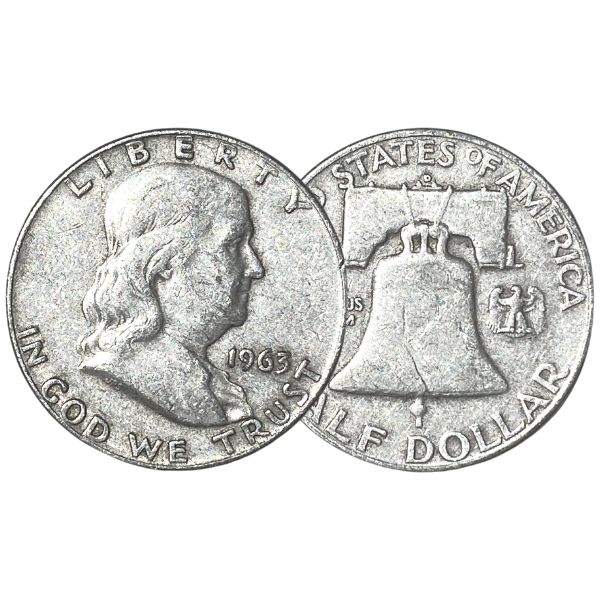
Franklin half dollars were minted from 1948 until 1963, so all Franklin half dollars contain 90% pure silver. How much silver is in a Franklin half dollar? Since Franklin half dollars weigh 12.5 grams and contain 90% pure silver, the silver weight of a standard Franklin Half Dollar is 11.25 grams, or .3617 troy ounces.
Half Dollar Silver Weight (1965-1970)
After the passage of the Coinage Act of 1965, the U.S. Mint stopped minting circulating coins using 90% pure silver. Most coins ceased having any silver at all, but the half dollar was briefly minted with 40% pure silver. From 1965-1970, the silver content of Kennedy half dollars was reduced to 40%, making their total silver weight 4.6 grams, or 0.1479 troy ounces. Following 1970, half dollars stopped containing any silver at all.
US Quarter Dollar Silver Weight (Pre-1965)

The modern US quarter dollar features George Washington and was first minted in 1932 to commemorate the founding father’s 200th birthday. Like most coins, the Washington quarter was minted with 90% pure silver until 1965, when the U.S. Mint transitioned it into a cheaper copper-nickel alloy as bullion prices began to climb. This means that Washington quarters contained 90% pure silver for 33 years from 1932 until 1964.
How much silver is in a Washington quarter? Quarter dollars minted in 1964 and earlier have a total weight of 6.25 grams and contain 90% fine silver, meaning that a pre-1965 Washington quarter contains 5.625 grams (0.1808 troy oz). Starting in 1965, quarter dollars meant for regular circulation contained no actual silver. Today, 90% silver quarters are collector’s items that help investors stack silver at an affordable price.
US Dime Silver Weight (Pre-1965)
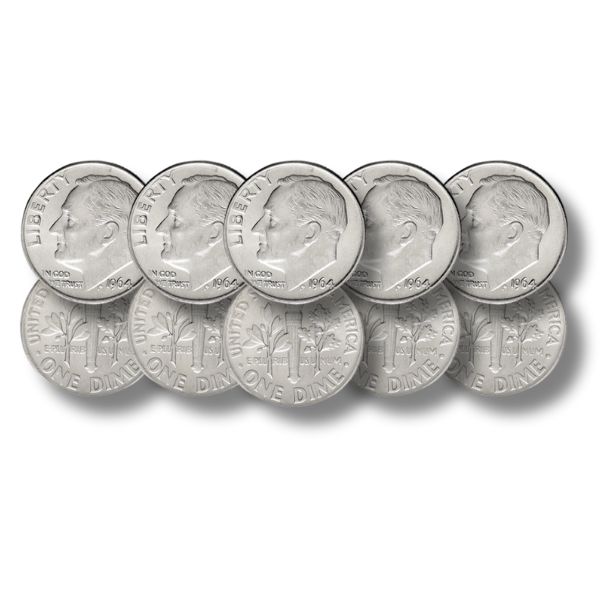
Like other circulating coins, US dimes were minted with 90% silver until the passage of the Coinage Act of 1965. How much silver is in a silver dime? A pre-1965 silver dime weighs 2.5 grams and is minted with 90% silver, meaning that its total silver weight is 2.25 grams, or .07234 troy ounces. Because of their size, silver dimes aren’t usually worth very much money, but they do sell for much more than their face value of $.10.
Dimes stopped being silver in 1965 after the passage of the Coinage Act, just like most American currency coins. Today, U.S. dimes contain no silver and are instead made using an alloy of 91.67% copper and 8.33% nickel. Modern dimes also weigh less, like many modern currency coins, since they don’t contain any actual silver bullion.
US “War Nickel” Silver Weight (1942-1945)
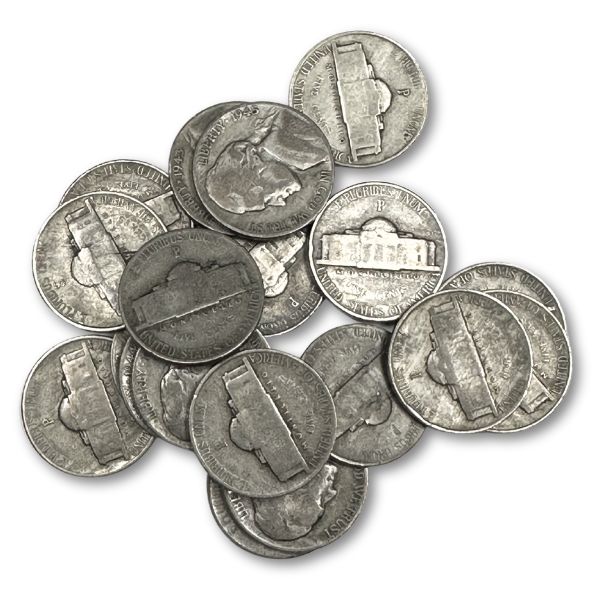
Nickels are the only major exception to the rule that pre-1965 circulating coins generally contain 90% pure silver. In fact, the composition of a US nickel has remained the same at 75% copper and 25% nickel for most of the coin’s history. However, silver nickels do exist. For a period of about two and a half years, the U.S. Mint produced nickels with 35% silver instead of the standard 75% copper and 25% nickel.
Nickels produced from mid-1942 until 1945 contain 35% pure silver and are called “Wartime Nickels.” During World War Two, nickel was a vital component in the war effort and was used to produce nickel steel for use in ships, submarines, and some weapons. As a result, the U.S. Mint was ordered to mint nickels with 35% silver in order to conserve more raw nickel for the war effort.
How much silver is in a Wartime Nickel? Wartime Nickels weigh 5 grams, contain 35% silver, and have a total silver weight of 1.75 grams (0.0563 troy oz). These coins can sometimes command a premium over melt value, particularly if they’re in great condition and sold to collectors interested in the WWII period.
The Story Behind War Nickels
The story of Wartime Nickels sheds some light on the practice of total war, a strategy where nations utilize all available military and civilian resources to further the war effort. During a period of total war, nearly every citizen and organization in a country is expected to contribute in some capacity to fueling the success of their nation’s military. Wartime Nickels demonstrate how even the United States Mint got involved in the “total war” effort of the United States military as it fought Germany and the Axis Powers.
During World War Two, nickel was an important wartime resource. Nickel can be combined with steel to produce nickel-steel, a strong alloy used in ships, submarines, and a number of other important instruments of war in the 20th century. The problem? Much of the American supply of nickel was being used to produce nickels, the five-cent currency coin that had become one of the most popular coins in circulation during the 1940s.
Why did nickels feature silver in the 1940s? To free up more nickel for the war effort, the U.S. Mint began minting nickels with 35% silver in mid-1942. The mint continued including 35% silver in its nickels until 1945, when World War Two ended. Silver nickels produced from 1942 until 1945, called Wartime Nickels, are popular collector’s items valued for their historical importance and silver content.
Aside from Wartime Nickels, nickels produced in the modern era never included pure silver.
Fun Fact – Here’s How Much Silver the U.S. Mint Produced in 1964
1964 was the last year that the United States Mint used 90% silver to manufacture its quarters, half dollars, and dimes. Because we now know the silver weight and mintage figures for all three of these silver coin denominations in 1964, it is possible to figure out exactly how much silver the U.S. Mint distributed through circulating coins in the final year of the country’s tradition of silver coinage.
Let’s start with the numbers.
The U.S. Mint produced 1,357,517,180 1964-D silver dimes in 1964, along with 929,360,000 Philadelphia dimes and 3,950,762 proof dimes. That’s a total of 2,290,827,942 dimes. We know that a 1964 Roosevelt dime contains 2.25 grams of pure silver. That means that the U.S. Mint minted 5,154,362,869.5 grams, or 165,716,614.34 troy ounces of silver in dimes during 1964.
As for quarters, the U.S. Mint produced a total of 1,268,476,875 coins across its proof, Philadelphia, and Denver series. Given the silver weight of a 1964 quarter, that’s a total of 7,135,182,421.88 grams (229,401,441.7668 troy ounces) in pure silver.
Kennedy half dollars had the lowest mintage of the three silver coins in 1964. A total of 383,460,212 silver Kennedy half dollars were minted in 1964, each of which contained 11.25 grams of pure silver. In 1964, the U.S. Mint used a whopping 4,313,927,385 grams, or 138,695,986.0706 troy ounces, of silver to make Kennedy half dollars.
Now, let’s put it all together to figure out how much silver the U.S. Mint used to make its silver currency coins in 1964.
In 1964, the U.S. Mint produced coins containing a grand total of 533,814,042.177 troy ounces. That’s over 533 million troy ounces of silver bullion. Today, the total value of the U.S. Mint’s silver used in 1964 would be worth over $32.7 billion.
Final Thoughts: How Much Silver Does Your US Coin Contain?
Figuring out the silver content of an American coin may seem tricky, but the process is actually pretty simple. Multiply the total weight of your currency coin by the coin’s silver percentage as a decimal (usually .90) to find out how much silver it contains. Modern currency coins meant for circulation contain no real silver, but silver coins remain an iconic piece of American history and can be quite valuable to collectors.
Be sure to check your coin jar for pre-1965 quarters, dimes, and half dollars. Who knows – you may be sitting on a fortune in silver!
You might also be interested in:


About The Author

Michael Roets
With over six years of experience reporting on precious metals, Michael Roets covers market news, buying guides, and commentary for Hero Bullion.