








Imperial German Gold, One Kingdom at a Time
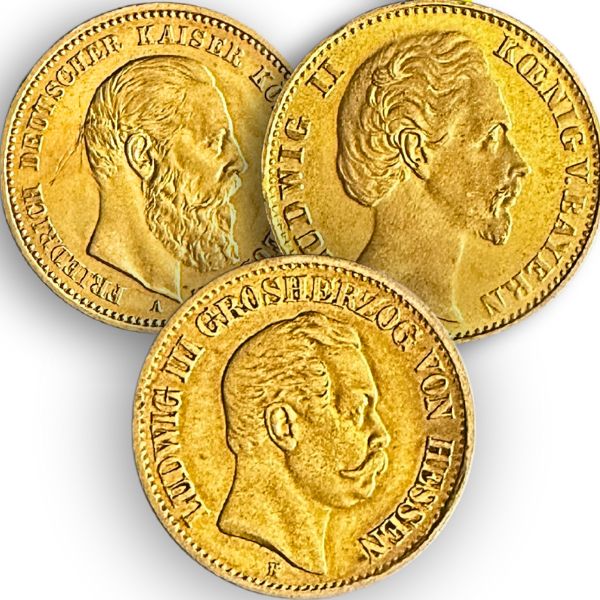
The German 10 Mark is a gold coin of the German Empire, struck from 1873 until gold coinage stopped in 1915. It holds .1152 troy ounces of gold in a .900 fine alloy and measures 19.5 mm across. Each German state struck its own, with its own ruler on the front, so the coin you receive may come from Prussia, Bavaria, Hesse, or another state. The date and condition vary too.
The Coin the Mark Was Built On
The German mark started out defined by gold. A law of 4 December 1871 took a new imperial gold coin worth ten marks and named one tenth of it a mark. That coin is this one. The gold standard fixed how much gold every mark stood for, and that fixed amount is what sits in each 10 Mark piece. Germany dropped the gold backing in August 1914, and gold coins stopped circulating.
Many Rulers, One Eagle
The portrait side belonged to the states. Our examples show three of them: Friedrich, as Deutscher Kaiser and King of Prussia, Ludwig II, König von Bayern, and Ludwig III, Grossherzog von Hessen. The other side was the same for every state, the crowned imperial eagle with DEUTSCHES REICH above it, the date, and 10 MARK below. That shared reverse is what made a Bavarian 10 Mark spend the same as a Prussian one.
Reading the Coin You Get
The legend around the portrait names the ruler and the state. A small letter below the portrait is the mint mark. A stands for Berlin, D for Munich, F for Stuttgart, G for Karlsruhe, and J for Hamburg, and our Hesse example carries an H. The date sits on the eagle side, after DEUTSCHES REICH. Put together, those three details tell you which issue you hold.
Circulated Gold, Not Uniform Stock
These coins were made to be spent, and most were. Expect wear, light marks, and toning that differ from coin to coin and from our photos. The .900 alloy, with its tenth of other metal, is what let them stand up to daily use. The state, ruler, date, and condition of your coin will vary, so this listing suits buyers who want historic German gold rather than one particular issue.
Germany 10 Mark Gold Coin Specifications
This coin contains .1152 troy ounces of .900 fine gold. It measures 19.5 mm across and 0.9 mm thick, with a reeded edge, and carries a 10 Mark denomination. Condition varies. Full details are on the Specifications tab above.
Germany 10 Mark Gold Coin FAQ
Which German state will my coin come from?
It varies. The listing covers 10 Mark coins from different states, and the ruler, state, and date are not set in advance.
How much gold is in a 10 Mark coin?
Each holds .1152 troy ounces of gold in a .900 fine alloy, the amount the gold standard set for ten marks.
What does the letter under the portrait mean?
It is the mint mark. A is Berlin, D is Munich, F is Stuttgart, G is Karlsruhe, and J is Hamburg.
Why does the eagle side say Deutsches Reich?
That means German Empire. Every state used the same imperial eagle reverse, so the coins worked as one national currency.
When did Germany stop making gold marks?
Gold coin production stopped in 1915, after Germany ended the gold backing of the mark in August 1914.
Exploring older European gold? Browse our European gold coins.
Add the Germany 10 Mark Gold Coin to your cart.
Product Reviews
Login to ReviewThere are no reviews yet.