










Two troy ounces gives a round the canvas to do something a one-ounce piece simply cannot — and the Aztec Calendar 2 oz Silver Round uses every millimeter of that larger diameter to reproduce one of the most complex and historically significant designs in pre-Columbian art. Paired with a portrait reverse of genuine numismatic character, this round delivers two troy ounces of .999 fine silver with serious design ambition on both faces.
Key Features:
- Purity and weight: 2 troy ounces, .999 fine silver
- Metal type: Silver
- Obverse design: Full reproduction of the Aztec Sun Stone (Calendar Stone) — the solar deity Tonatiuh at center, surrounded by concentric rings of the 20 day-signs, 8 points of the sun, serpent heads, and outer border glyphs, filling the entire coin face
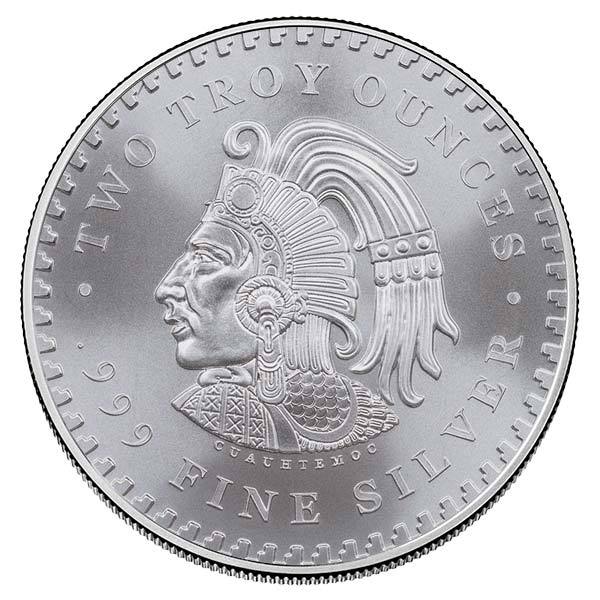
- Reverse design: Left-facing portrait of Cuauhtémoc, last emperor of the Aztecs, in full ceremonial feathered headdress and scaled armor collar, inscribed “TWO TROY OUNCES .999 FINE SILVER” with his name below the portrait
- IRA Eligible
- Minted by the Golden State Mint
The obverse reproduces the Aztec Sun Stone — commonly known as the Aztec Calendar — with remarkable fidelity given the complexity of the source material. At the absolute center sits the face of Tonatiuh, the Aztec sun deity, his tongue extended downward in the form of a sacrificial knife, surrounded by four square panels representing the four previous suns or world ages in Aztec cosmology. Immediately encircling this central figure is the ring of twenty day-signs — the named days of the Aztec ritual calendar — each glyph individually rendered in its proper sequence. Moving outward, a band of eight triangular sun points alternates with decorative elements, followed by further rings of glyphs, dots, and geometric patterns that build outward in layer after layer of compressed symbolic detail. The outermost ring depicts two massive feathered serpents whose bodies frame the entire composition, their heads meeting at the bottom of the stone. The original stone, carved from basalt and measuring nearly twelve feet across, was rediscovered beneath Mexico City in 1790 and is now housed in the National Museum of Anthropology in Mexico City. The round’s larger two-ounce diameter allows the engraving to capture the nested ring structure with enough resolution to distinguish individual glyphs across every band.
The reverse steps back from the abstract to present a formal portrait. Cuauhtémoc — the last ruling emperor of the Aztec Empire, who led the defense of Tenochtitlan against Spanish forces in 1521 — faces left in sharp profile. He wears an elaborate feathered headdress, its plumes layered and swept back in fine detail, with a decorated headband at the base. A scaled or quilted armor collar covers his shoulders and upper chest, its surface pattern carefully struck. His facial features are composed and dignified. His name “CUAUHTEMOC” is engraved below the portrait truncation. “TWO TROY OUNCES” arcs along the top of the field, with “.999 FINE SILVER” along the bottom, the reeded border running the full circumference.
For collectors drawn to Mesoamerican history and iconography, this round pairs two of the most iconic subjects from Aztec civilization into a single, substantial piece of silver. Add it to your cart today.
justin.h (verified owner) –
Even better than the 1oz, you can really see the detail.